Vasmed : Redefining Precision Engineering with Indigenous Pressure Sensing PTCA Guidewire
Owing to sedentary lifestyles, unhealthy diets, and excessive tobacco & alcohol consumption, there has been a sharp increase in the number of cardiovascular Diseases (CVDs) across India in recent times. Experts estimates over 500,000 Percutaneous Coronary Interventions (as of 2022) being performed and more than 550,000 stents being implanted every year in India. Given the highly complex and critical nature of these minimally invasive interventions, there has been a heightened demand for advanced high-precision medical devices such as Percutaneous Transluminal Coronary Angioplasty (PTCA) guidewires which are still being imported from abroad.
Striving towards complete indigenization of such hightech medical equipment is Vasmed Health Sciences (VHS). The Indian division of UAE-based Vasmed Group which is into interventional cardiology products since 2003, VHS was started in 2019 with a vision to help individuals with terminal illnesses live healthier lives by leveraging cutting-edge technologies to develop top-notch quality medical devices within India. Focused solely on the critical engineering aspect of the product development process for interventional cardiology and other active medical devices, VHS prides on operating India’s only end-to-end research and manufacturing facility for PTCA guidewires today.
Diverse Portfolio of Offerings
In addition to manufacturing, VHS offers a wide range of Research & Development services that include Concept Development & Feasibility Studies, Design & Engineering, Prototyping & Testing, and Manufacturing & Commercialization of Active Medical devices from EU MDR Class-III and Class-II devices (CDSCO Class D, Class C and Class B devices). Some of the major devices that VHS has developed include fibre-optic invasive blood pressure monitors, oxygen concentrators, neuromodulation devices, and high-specification ICU ventilators.
“While our guidewires are CE marked, our entire manufacturing facility & services operations are ISO 13485 certified, with CDSCO manufacturing license for Class D devices. Our core-competency is in the ability to realize a class-III active/passive medical device from concept to certification and manufacture them internally. Along with only a handful of multinational conglomerates, we are among the very few end-to-end PTCA guidewire manufacturers in the country with full in-house design and manufacturing capabilities”, says Anoop Varghese, Chief Operating Officer & Program Manager, Vasmed Health Sciences.
Our IBP sensor allows clinicians to use a standard guidewire to accurately measure blood pressure directly at the site of a lesion, aiding in the assessment of its severity
World-class Precision Engineering Capabilities
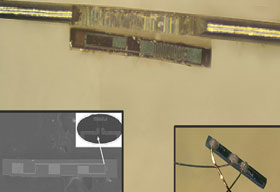
Yet another highlight of VHS’ tech prowess and top-notch engineering capabilities is the pressure sensing guidewire which incorporates a Piezo Resistive MEMS Pressure sensor that was indigenously developed in collaboration with IISc. For invasive blood pressure monitoring primarily in the coronary artery, reaching the sensing device to the area of interest is challenging, as the device needs to be navigated to position from an incision in the femoral artery or radial artery. Standard sensors available in the market measure 0.33 microns, but are very difficult to be integrated a 0.35mm PTCA guidewire and are only being imported from abroad.
To develop this technology indigenously, VHS partnered with IISc’s Centre for Nano Sciences (CeNSE) to design and fabricate a die cross section of 0.15x0.15mm (150 x 150 micron). Achieved under able guidance and technology prowess of Prof. Navakanta Bhat, Late Prof. K N Bhat, and Prof. M.M Nayak, and research scholar Linet Thomas C at IISc, the process of packaging the IBP sensor into the guidewire including the wire bonding and the electronics for integration was designed, developed and calibrated by Vasmed from scratch.
“At 150x150 microns, this is one of the smallest sensors being used for Invasive blood pressure monitoring and allows clinicians to use a standard guidewire to accurately measure blood pressure directly at the site of a lesion, aiding in the assessment of its severity of the lesion. The project has overcome significant technical challenges, requiring the internal development of specialized algorithms for temperature compensation and a novel micro-wire bonding technique. Having successfully passed all requisite IEC 60601 series safety & performance standards and biocompatibility testing, we’re currently in the process of mass manufacturing the dies for the sensor with Central Manufacturing Technology Institute (CMTI) Bengaluru”, adds Anoop.
Star-studded Business Journey
Having been in the industry for over two decades now, there are over 100,000 Vasmed stents being used worldwide today without any adverse events. As a standing testimony to VHS’ multidisciplinary R&D expertise, it was among the only nine global suppliers that were licensed to develop and manufacture the JP VITAL ventilators during Covid and has even collaborated with the IISc to develop their CenSpire ventilator. Further, the company’s IBP system was also enlisted for Innovative Products Grant from National Biomedical Mission (NBM) and Biotechnology Industry Research Assistance Council (BIRAC).
Currently working on multiple technologies such as an ICP (intra-cranial pressure) monitoring system, VHS envisions driving indigenous technology development to overcome reliance on imported products. Already undergoing CDSCO approval, this pressure-sensing guidewire system is expected to be launched into market in Q2 of 2026. The joint patent application for the design with IISc is in the final stage of approval and Vasmed is in talks CMTI Bengaluru for the commercial fabrication of the sensors as well.